
If you’re teaching in Lambeth – or thinking of starting your career here – flexible working is no longer a niche perk reserved for a lucky few.
From April 2024, every employee in England has a day-one legal right to request flexible working. You can now make two statutory requests in any 12-month period, and your school must respond within two months, after a proper consultation.
Alongside that legal shift, the Department for Education (DfE) has updated its Flexible working in schools guidance (November 2024), which actively encourages schools and trusts to build flexible working into their staffing strategy – not just to say “yes” or “no” to one-off requests.
Teach Lambeth can’t promise how every individual school will respond. What we can do is show you:
what the law and DfE guidance actually say
what kinds of patterns are now explicitly on the table
how a well-run Lambeth school might use those tools to keep good teachers in the classroom
how to make a strong, realistic request if flexibility would help you stay in the job
Think of this as the blueprint for what we’d like flexible working in Lambeth schools to look like.
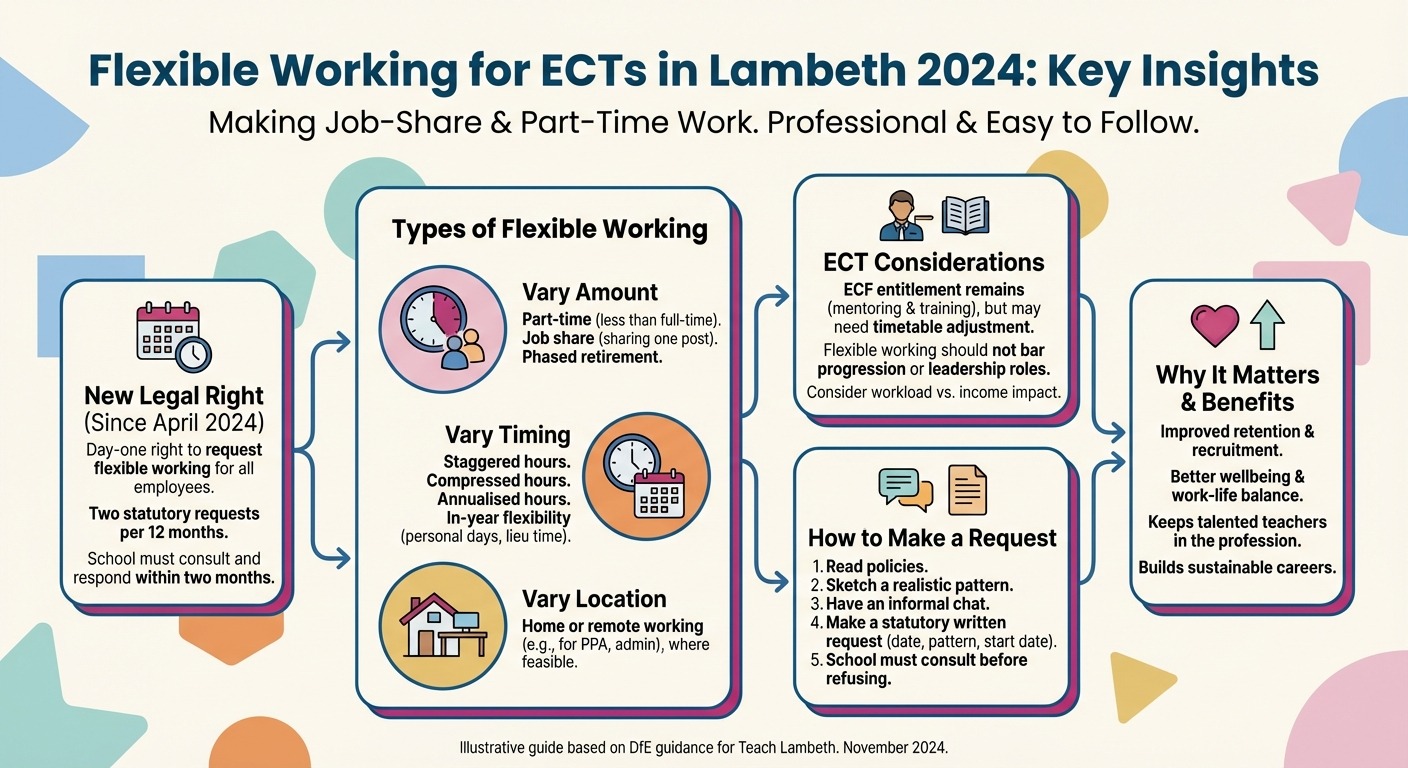
1. What “Flexible Working” Means Now
The DfE defines flexible working in schools as “arrangements which allow employees to vary the amount, timing, or location of their work.”
That definition is deliberately broad. In practice, the guidance groups common options into a few families:
Changing the amount of time you work
Part-time working – anything less than full-time hours.
Job share – two (or more) people sharing one post and splitting the hours.
Phased retirement – gradually reducing hours or responsibilities as you move towards retirement.
Changing when you work
Staggered hours – different start/finish times.
Compressed hours – full-time hours over fewer days.
Annualised hours – hours spread unevenly across the year, sometimes including some school-closure days.
Building in in-year flexibility
Personal or family days – a set number of authorised term-time days for all staff.
Lieu time – paid time off in return for agreed extra hours (for example, residential trips).
Changing where you work
Home or remote working – usually for tasks like planning, preparation and assessment (PPA), leadership admin or CPD, where safeguarding and practicalities allow. The DfE now explicitly notes that teachers can use their PPA time flexibly at home and in one block, where it works operationally.
No school is expected to offer every option to every member of staff. But all of these are now explicitly recognised as valid patterns to explore.
2. Your Legal Right to Request Flexible Working
Since April 2024, the statutory framework has shifted in your favour. Under amendments to the Employment Rights Act 1996 and the Employment Relations (Flexible Working) Act 2023:
You can request flexible working from day one of employment (no 26-week qualifying period).
You can make up to two statutory requests in any 12-month period.
Your school must consult with you before refusing a statutory request.
The school must conclude the process within two months, including any appeal (unless you both agree a longer deadline).
You no longer have to explain the impact your request will have on the school or how to solve it – that responsibility sits with the employer.
A statutory request must be in writing and must say:
that it’s a statutory request for flexible working
the date of the request
the pattern you’re asking for and when you’d like it to start
any previous requests in the last 12 months
The school can still say no – but only for recognised business reasons (for example, serious timetabling difficulty or unacceptable impact on quality or performance).
So this isn’t a right to work flexibly on your own terms. It’s a clear right to have your request heard properly, considered fairly, and answered promptly.3. Why Flexible Working Matters for Schools – and for You
The DfE’s guidance and research are very clear on why flexible working is worth taking seriously. Schools that plan for flexibility report:
Better retention of experienced staff – particularly those with caring responsibilities.
More attractive recruitment, widening the pool of applicants.
Improved wellbeing and work–life balance, which links to lower absence and stronger classroom performance.
Greater capacity to keep talented teachers in middle and senior leadership by making those roles workable part-time or in job-share.
There are challenges – timetabling, handover time for job-shares, parent perceptions, and the risk of overloading part-time staff. The DfE explicitly acknowledges these and encourages schools to use trial periods, redesign roles where necessary, and think strategically about flexible working rather than treating each request in isolation.
In a borough like Lambeth, where recruitment and retention are constant priorities, flexible working done well could be a powerful part of the answer.
4. What “Good” Could Look Like in a Lambeth School
Because Teach Lambeth works with schools across the borough, we see a range of approaches. Rather than claim that every school already does all of this, here’s what good practice – fully aligned with DfE guidance – might look like in Lambeth:
Every school has a clear, published flexible working policy, based on national law and the DfE guidance, that applies from day one of employment.
Timetabling is planned with flexibility in mind – for example, building in the possibility of paired classes that could be covered by job-share partners.
Personal or family days, if offered, are open to all roles, with transparent criteria rather than case-by-case favours.
Part-time and job-share staff get proper handover time and clarity about who does what – especially around parents’ evenings, reports and safeguarding.
PPA is scheduled in meaningful blocks, and where safeguarding and logistics allow, teachers can use some or all of that time at home.
Flexible working is discussed in recruitment and retention planning, not only when someone is about to quit.
The Lambeth Schools Partnership already provides shared HR model policies and school-improvement support; flexible working fits naturally into that wider culture of collaboration.
But the detail – what’s viable on your timetable, in your department – will always come down to conversations inside your school.5. Thinking About Flexible Working as an ECT
If you’re in your ECT years, you have a few extra things to weigh up.
Your entitlement to ECF support remainsThe Early Career Framework (ECF) sets out your entitlement to a two-year package of mentoring and training. That entitlement applies whether you’re full-time, part-time or in a job-share – but the timetable and pacing may need to be adjusted.
Workload vs. income Dropping hours can help with energy and wellbeing, but it comes with a real hit to take-home pay. Part-time staff often say the key is redesigning the role – not doing a full-time job in fewer days.
Progression and responsibility DfE guidance is explicit that leadership roles and teaching and learning responsibilities can be held on flexible patterns, and that schools should not assume flexible working is a barrier to progression.
In reality, you need to judge your own development curve. For some ECTs, two solid full-time years give the strongest base. For others, flexible working is what keeps them in the profession at all.
6. How to Make a Strong Flexible Working Request
Whether you’re a brand-new ECT or a mid-career teacher, the process is the same. The DfE and Acas both recommend starting with an informal conversation, then making a statutory request if you want a formal, contractual change.
Step 1: Read the policies
Your school’s flexible working policy (or HR policy if there’s no separate one).
Any guidance from your trust or from Lambeth Schools Partnership shared with schools.
Look for: deadlines (for example, before timetable construction), named contacts, and whether there’s a standard form.
Step 2: Sketch a pattern that actually works
Consider:
Timetable pinch-points (exam classes, core subjects).
Handover arrangements if you’re proposing a job share.
How meetings, duties and parents’ evenings would be covered.
The law no longer requires you to explain the impact on the school, but doing that thinking makes it much harder for a reasonable school to say no.
Step 3: Have the informal conversation
Talk to your line manager or headteacher before you submit anything formal. Explore:
Whether there are obvious blocks (e.g. two other staff in the same key stage already working 0.6).
Whether a trial period would help everyone test the pattern.
Step 4: Make the statutory request (if you want a formal change)
Put it in writing:
Say clearly it’s a statutory flexible working request.
Include the date, the pattern you’re requesting, the start date, and any previous requests in the last 12 months.
The school must then:
Consult with you before refusing.
Give a decision (including any appeal) within two months, unless you both agree to extend.
If agreed, the change is normally permanent unless you both agree it’s for a fixed period.
Step 5: Get support if needed
Your union can:
Help you frame the request.
Accompany you to meetings (where policy allows).
Advise you if a refusal feels unfair or discriminatory.
7. Questions Teachers Often Ask
“Can I ask to go part time as an ECT?” Yes – the law applies from day one of your contract, and the DfE guidance is clear that flexible working is open to all staff, including those in their early career. But your school still needs to balance that request against timetable and curriculum needs.
“If my request is refused, is that the end of it?” Not necessarily. Schools can refuse only for legitimate business reasons, and they must consult with you before doing so. You can suggest alternatives, ask for a trial period, or appeal under the school’s policy.
“Will flexible working damage my chances of promotion?” The DfE explicitly warns against assuming that part-time or flexible staff can’t hold leadership or TLR roles, and encourages schools to design roles so experienced staff can stay and progress.
“Can I work from home for all my PPA?” No one has an automatic right to that, but the guidance does say that teachers can use PPA flexibly at home where it is operationally feasible and safeguarding allows. It’s something to discuss with your school as part of a wider flexible-working plan.8. Looking Ahead
Flexible working will not, on its own, solve every workload and retention problem in schools. But the legal and policy landscape has shifted decisively:
You can request flexibility from day one.
Schools are encouraged – strongly – to think strategically about how they use it.
For Lambeth, that’s an opportunity. A borough that already prides itself on collaboration and inclusion can use flexible working to keep brilliant teachers in its classrooms for longer – especially those who might otherwise feel they have to choose between teaching and the rest of their lives.
If you’re considering a flexible pattern, don’t wait until you’re at breaking point. Read the policies, talk to your mentor or line manager, and start the conversation early. Used well, flexible working isn’t a sign of “not coping”; it’s a way of building a sustainable career in a profession that needs you to stay.