
If you’re an Early Career Teacher, the words “Ofsted inspection” can carry a lot of weight — often more than they should. It’s easy to feel as if an inspection is something you perform for, rather than something that reflects what your school does every day.
The good news is that the inspection system itself is changing. England has moved away from the old model where schools were primarily defined in the public imagination by a single headline judgement. In its place is a new approach based on report cards, with separate graded areas and short narrative explanations.
This article explains what’s changing, what it means for teachers — especially ECTs — and what sensible preparation looks like if your school is inspected.
What’s actually changing
The key shift is simple:
Ofsted no longer gives one overall judgement like “outstanding” or “good”.
Instead, inspection outcomes are shown through a report card. That report card presents:
colour-coded grades for different areas of school life
a short narrative explanation alongside each grade
a separate judgement on safeguarding: “met” or “not met”
This is designed to give parents and the public a more detailed picture, and to stop one headline word becoming the entire story of a school.
The timeline (so you’re working off the right assumptions)
This change arrived in stages.
The DfE described the removal of single headline grades as the first step in a reformed accountability system beginning September 2024.
The new Education Inspection Framework and report card approach applies from November 2025.
In January 2026 the first set of 22 report cards were published for a set of volunteer schools
So if you’re teaching now, the report-card model isn’t a distant idea — it’s already the framework schools are operating under.
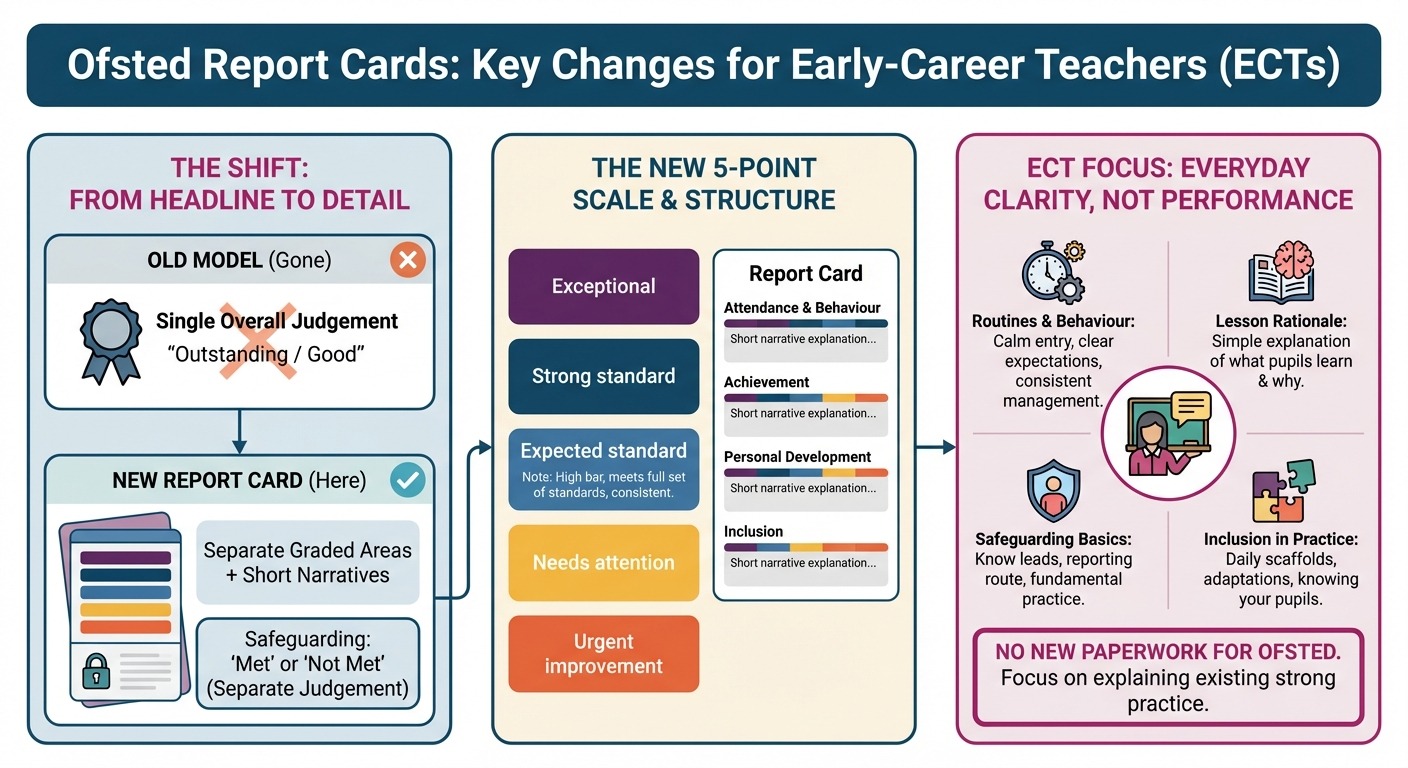
The new five-point scale
Each graded area on the report card uses a five-point scale:
Exceptional
Strong standard
Expected standard
Needs attention
Urgent improvement
Safeguarding sits separately and is recorded as “met” or “not met”.
Two details matter for teachers:
1) “Expected standard” is meant to be a high bar
Ofsted explicitly describes “expected standard” as meeting the full set of standards, including legal requirements and statutory guidance.
So “expected standard” is not supposed to mean “just about okay.” It’s meant to mean the school is doing what it should, consistently, at a secure level.
2) You can’t translate these grades back into the old system
Ofsted is explicit that the new grades cannot be compared to the old single-word judgements, because it’s a different reporting approach.
That’s important for staff wellbeing and morale. The temptation to mentally convert “expected standard” into “good”, or “needs attention” into “requires improvement”, is understandable — but it’s not what the framework says.
What gets graded on the report card
Rather than one overall label, report cards show grades for different areas of education. Ofsted’s public guidance gives examples such as:
attendance and behaviour
achievement
personal development and wellbeing
inclusion
leadership and governance
curriculum and teaching
The core point for teachers is that inspection outcomes are now more granular. A school can be strong in some areas and clearly have work to do in others — and that nuance is part of the design.
Safeguarding remains separate and is judged as “met/not met”.
What about “staff wellbeing lines”?
You’ll hear a lot of discussion about whether the new framework changes how inspections feel for staff. Ofsted has publicly said it intends an increased focus on professionals’ wellbeing and workload through a more collaborative approach.
What that doesn’t mean is that inspections become “easy” or that workload disappears overnight. But it does point to a shift in tone: a move away from inspections feeling like a hunt for failure, and toward inspections trying to explain what is happening in a school and why.
The most sensible way to think about this as a teacher is:
you shouldn’t be expected to create extra paperwork “for Ofsted”
you shouldn’t be doing performative tasks that don’t improve learning
the goal is everyday clarity: routines, curriculum, inclusion and safeguarding understood and applied consistently
That is still demanding. It’s just a different kind of demand.
What this means for ECTs and classroom teachers
If you’re early in your career, the biggest risk is thinking inspection preparation means becoming someone else for a week.
In reality, what inspectors can see — and what matters most — is usually the normal stuff:
whether pupils know the routines and expectations
whether behaviour is managed consistently
whether lessons build logically and pupils learn what they’re meant to learn
whether you can explain your choices simply and calmly
whether safeguarding and inclusion are understood as part of daily practice, not a separate “file”
You’re not expected to be the school’s spokesperson. You are expected to be a competent professional who can talk about your classroom.
Practical preparation: what to do if your school is inspected
A good way to prepare is to focus on what you can control.
Know your classroom routines
Inspectors may observe only a short snapshot. Calm entry routines, clear instructions, and predictable transitions make a huge difference.
Be able to explain your lesson simply
Not a speech. Just: what pupils are learning, why this matters, and how you’ll check understanding.
Be clear on behaviour expectations
If you’re asked, you should be able to describe the behaviour approach and what you do when pupils meet or fall below expectations.
Know your safeguarding basics
You should know your school’s safeguarding leads, the reporting route, and what to do if something concerns you. Safeguarding is judged separately and remains fundamental.
Be ready to speak about inclusion in practical terms
If your class includes pupils with SEND, EAL needs, or significant vulnerability, focus on what you actually do day to day: scaffolds, routines, adaptations, relationships, and how you work with colleagues.
Don’t create new paperwork
If you find yourself generating new documents solely because of inspection anxiety, pause. Strong schools don’t “perform”; they explain what they already do.
Final thoughts
For teachers in Lambeth — ECTs and experienced staff alike — the inspection framework is now more detailed and more nuanced than the old single-word system. Report cards are designed to show strengths and next steps clearly, rather than compressing a school into one label.
The best preparation is still the same: calm, consistent practice; clear routines; strong safeguarding; and a shared understanding across staff of how your school supports pupils to learn and thrive.
If you focus on those basics, inspection becomes less about fear — and more about professional confidence.